登录


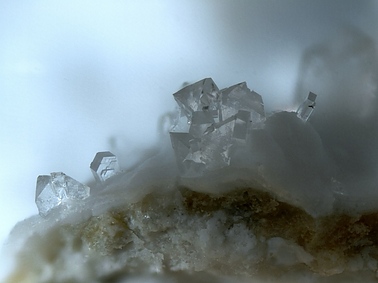
Gismondine-Sr
A valid IMA mineral species
This page is currently not sponsored. Click here to sponsor this page.




About Gismondine-Sr

Carlo Giuseppe Gismondi (1762-1824)
Formula:
Sr4(Si8Al8O32) · 9H2O
Colour:
White
Lustre:
Vitreous
Hardness:
4
Specific Gravity:
2.301 (Calculated)
Crystal System:
Orthorhombic
Member of:
Name:
Named for being the strontium analogue of gismondine-Ca. The root name relates to Carlo Giuseppe Gismondi (1762-1824), Italian mineralogist, who previously discovered a mixture of gismondine-Ca and phillipsite. The suffix/modifier follows the naming convention for zeolites and denotes the dominant extra-framework cation.
Unique Identifiers
Mindat ID:
55600
Long-form identifier:
mindat:1:1:55600:0
IMA Classification of Gismondine-Sr
Approved
IMA Formula:
Sr4(Si8Al8O32)·9H2O
Approval year:
2021
First published:
2023
Approval history:
IMA No. 2021-043
Type description reference:
Skrzyńska, Katarzyna, Cametti, Georgia, Galuskina, Irina O., Vapnik, Yevgeny, Galuskin, Evgeny V. (2023) Gismondine-Sr, Sr4(Al8Si8O32)·9H2O, a new strontium dominant, orthorhombic zeolite of the gismondine series from the Hatrurim Complex, Israel. American Mineralogist, 108 (2) 249-258 doi:10.2138/am-2022-8376
Classification of Gismondine-Sr
9.GC.
9 : SILICATES (Germanates)
G : Tektosilicates with zeolitic H2O; zeolite family
C : Chains of doubly-connected 4-membered rings
9 : SILICATES (Germanates)
G : Tektosilicates with zeolitic H2O; zeolite family
C : Chains of doubly-connected 4-membered rings
Mineral Symbols
As of 2021 there are now IMA–CNMNC approved mineral symbols (abbreviations) for each mineral species, useful for tables and diagrams.
| Symbol | Source | Reference for Standard |
|---|---|---|
| Gis-Sr | IMA–CNMNC | Warr, L.N. (2021). IMA–CNMNC approved mineral symbols. Mineralogical Magazine, 85(3), 291-320. doi:10.1180/mgm.2021.43 |
Physical Properties of Gismondine-Sr
Vitreous
Transparency:
Transparent, Translucent
Colour:
White
Streak:
White
Hardness:
4 on Mohs scale
Hardness:
VHN25=302(8) kg/mm2 - Vickers
Tenacity:
Brittle
Cleavage:
Imperfect/Fair
Imperfect on [101].
Imperfect on [101].
Fracture:
Irregular/Uneven
Density:
2.301 g/cm3 (Calculated)
Comment:
Could not be measured due to a microcracks and a high degree of hydration.
Optical Data of Gismondine-Sr
Type:
Biaxial (-)
RI values:
nα = 1.488(3) nβ = 1.492(3) nγ = 1.495(3)
2V:
Measured: 70° to 80°, Calculated: 81.8°
Max. Birefringence:
δ = 0.007
Based on recorded range of RI values above.
Based on recorded range of RI values above.
Interference Colours:
The colours simulate birefringence patterns seen in thin section under crossed polars. They do not take into account mineral colouration or opacity.
Michel-Levy Bar The default colours simulate the birefringence range for a 30 µm thin-section thickness. Adjust the slider to simulate a different thickness.
Grain Simulation You can rotate the grain simulation to show how this range might look as you rotated a sample under crossed polars. Each grain retains its interference colour (retardation) while its brightness falls to black at extinction and reaches a maximum between extinction positions.
Surface Relief:
Moderate (negative)
Relative to Canada balsam mounting medium (n ≈ 1.537).
Relative to Canada balsam mounting medium (n ≈ 1.537).
This shows the grain boundary and Becke line effect under plane-polarised
light, based on the contrast between this mineral's average refractive
index and the mounting medium. It does not take into account mineral
colouration.
In focus
Interference Figure:
This shows the idealized biaxial acute bisectrix (Bxa) interference figure
- the conoscopic view for a grain cut perpendicular to the acute bisectrix, using
this mineral's 2V. The two small white dots mark the melatopes - the points
where the two optic axes emerge - and are shown only when they fall within the
field of view. The coloured bands are isochromatics, and the dark bands are
isogyres.
Rotate the stage: at 0°/90° the isogyres form a cross through the melatopes; at 45° they pull apart into curved hyperbolas. That splitting on rotation - absent in a uniaxial figure - is the standard diagnostic test for telling biaxial minerals from uniaxial ones. If 2V is large, the melatopes may fall outside the field of view, as they often do at the microscope too.
Rotate the stage: at 0°/90° the isogyres form a cross through the melatopes; at 45° they pull apart into curved hyperbolas. That splitting on rotation - absent in a uniaxial figure - is the standard diagnostic test for telling biaxial minerals from uniaxial ones. If 2V is large, the melatopes may fall outside the field of view, as they often do at the microscope too.
Chemistry of Gismondine-Sr
Mindat Formula:
Sr4(Si8Al8O32) · 9H2O
Element Weights:
Chemical Analysis
Empirical formulas:
| Sample ID | Empirical Formula |
|---|---|
| 1 | (Sr2.02Ca1.09Ba0.02K0.72Na0.62)?4.47Al7.91Si8.09O31.85·9H2O |
| 2 | (Sr1.74Ca1.05Ba0.09K1.56Na0.49)?4.93[Al7.98Si8.06O32]·9.62H2O |
Sample references:
Crystallography of Gismondine-Sr
Crystal System:
Orthorhombic
Class (H-M):
222 - Disphenoidal
Space Group:
C2221
Cell Parameters:
a = 14.0256(2) Å, b = 10.4590(1) Å, c = 13.7936(1) Å
Ratio:
a:b:c = 1.341 : 1 : 1.319
Unit Cell V:
2,023.43 ų (Calculated from Unit Cell)
Comment:
the space group is B2212 for comparison to gismondine-Ca
X-Ray Powder Diffraction
Powder Diffraction Data:
| d-spacing | Intensity |
|---|---|
| 7.165 Å | (34) |
| 4.917 Å | (100) |
| 4.192 Å | (88) |
| 4.167 Å | (46) |
| 3.128 Å | (47) |
| 2.683 Å | (34) |
| 2.663 Å | (25) |
| 2.615 Å | (29) |
Reference:
Skrzyńska, Katarzyna, Cametti, Georgia, Galuskina, Irina O., Vapnik, Yevgeny, Galuskin, Evgeny V. (2023) Gismondine-Sr, Sr4(Al8Si8O32)·9H2O, a new strontium dominant, orthorhombic zeolite of the gismondine series from the Hatrurim Complex, Israel. American Mineralogist, 108 (2) 249-258 doi:10.2138/am-2022-8376
Type Occurrence of Gismondine-Sr
General Appearance of Type Material:
Spherical aggregates to 180 μm or pseudotetragonal bipyramids to 50 μm.
Place of Conservation of Type Material:
Collections of the Fersman Mineralogical Museum, Russian Academy of Sciences, Leninskiy Prospekt 18-2, Moscow 119071, Russia, registration no. 5708/1.
Geological Setting of Type Material:
Gehlenite hornfels.
Associated Minerals at Type Locality:
Reference:
Skrzyńska, Katarzyna, Cametti, Georgia, Galuskina, Irina O., Vapnik, Yevgeny, Galuskin, Evgeny V. (2023) Gismondine-Sr, Sr4(Al8Si8O32)·9H2O, a new strontium dominant, orthorhombic zeolite of the gismondine series from the Hatrurim Complex, Israel. American Mineralogist, 108 (2) 249-258 doi:10.2138/am-2022-8376
Synonyms of Gismondine-Sr
Other Language Names for Gismondine-Sr
Dutch:Gismondien-Sr
German:Gismondin-Sr
Relationship of Gismondine-Sr to other Species
Member of:
Other Members of Gismondine Subgroup:
| 'Gismondine-Ba' | Ba2Al4Si4O16 · 4-6H2O | |
| Gismondine-Ca | CaAl2Si2O8 · 4H2O | Mon. 2/m : P21/c |
Common Associates
Associations Based on Photo Data:
| 3 photos of Gismondine-Sr associated with Flörkeite | (K3Ca2Na)[Al8Si8O32] · 12H2O |
| 2 photos of Gismondine-Sr associated with Gismondine-Ca | CaAl2Si2O8 · 4H2O |
| 1 photo of Gismondine-Sr associated with Tobermorite | Ca5Si6O17 · 5H2O |
Related Minerals - Strunz-mindat Grouping
| 9.GC. | Garronite-Na | Na6(Al6Si10O32) · 8.5H2O |
| 9.GC.05 | 'Gismondine-Ba' | Ba2Al4Si4O16 · 4-6H2O |
| 9.GC.05 | Garronite-Ca | Na2Ca5Al12Si20O64 · 27H2O |
| 9.GC.05 | Gismondine-Ca | CaAl2Si2O8 · 4H2O |
| 9.GC.05 | Gobbinsite | Na5(Si11Al5)O32 · 11H2O |
| 9.GC.05 | Amicite | K2Na2Al4Si4O16 · 5H2O |
| 9.GC.10 | Martinandresite | Ba2(Al4Si12O32) · 10H2O |
| 9.GC.10 | Harmotome | Ba2(Si12Al4)O32 · 12H2O |
| 9.GC.10 | Phillipsite-Ca | Ca3(Si10Al6)O32 · 12H2O |
| 9.GC.10 | Phillipsite-K | K6(Si10Al6)O32 · 12H2O |
| 9.GC.10 | Phillipsite-Na | (Na,K,Ca0.5,Ba0.5)4-7[Al4-7Si12-9O32] · 12H2O |
| 9.GC.10 | Flörkeite | (K3Ca2Na)[Al8Si8O32] · 12H2O |
| 9.GC.15 | Merlinoite | K5Ca2(Si23Al9)O64 · 24H2O |
| 9.GC.20 | Mazzite-Na | Na8[Al4Si14O36]2 · 30H2O |
| 9.GC.20 | Mazzite-Mg | (Mg,K,Ca)5(Si26Al10)O72 · 28H2O |
| 9.GC.25 | Perlialite | K9Na(Ca,Sr)[Al2Si4O12]6 · 15H2O |
| 9.GC.30 | Boggsite | Ca8Na3(Si,Al)96O192 · 70H2O |
| 9.GC.35 | Paulingite-Ca | (Ca,K,Na,Ba, ◻)10 (Si, Al)42O84 · 34H2O |
| 9.GC.35 | Paulingite-K | (K2,Ca,Na2,Ba)5[Al10Si35O90] · 45H2O |
| 9.GC.35 | 'Paulingite-Na' | (Na2,K2,Ca,Ba)5[Al10Si35O90] · 45H2O |
Fluorescence of Gismondine-Sr
None
Other Information
Notes:
Slowly dissolves in 10% HCl.
Health Risks:
No information on health risks for this material has been entered into the database. You should always treat mineral specimens with care.
Internet Links for Gismondine-Sr
mindat.org URL:
https://www.mindat.org/min-55600.html
Please feel free to link to this page.
Please feel free to link to this page.
Search Engines:
External Links:
Mineral Dealers:
References for Gismondine-Sr
Reference List:
Miyawaki, Ritsuro, Hatert, Frédéric, Pasero, Marco, Mills, Stuart J. (2021) IMA Commission on New Minerals, Nomenclature and Classification (CNMNC) CNMNC Newsletter No 63. Mineralogical Magazine, 85 (6) 910-915 doi:10.1180/mgm.2021.74
Skrzyńska, Katarzyna, Cametti, Georgia, Galuskina, Irina O., Vapnik, Yevgeny, Galuskin, Evgeny V. (2023) Gismondine-Sr, Sr4(Al8Si8O32)·9H2O, a new strontium dominant, orthorhombic zeolite of the gismondine series from the Hatrurim Complex, Israel. American Mineralogist, 108 (2) 249-258 doi:10.2138/am-2022-8376
Skrzyńska, Katarzyna, Cametti, Georgia, Juroszek, Rafał, Schӓfer, Christof, Galuskina, Irina (2023) New data on minerals with the GIS framework-type structure: gismondine-Sr from the Bellerberg volcano, Germany, and amicite and Ba-rich gismondine from the Hatrurim Complex, Israel. Mineralogical Magazine, 87 (3) 443-454 doi:10.1180/mgm.2023.27
Localities for Gismondine-Sr
Showing 2 localities.
 symbol to view information about a locality.
The
Locality List
 - This locality has map coordinates listed.
- This locality has estimated coordinates.
ⓘ - Click for references and further information on this occurrence.
? - Indicates mineral may be doubtful at this locality.
 - Good crystals or important locality for species.
 - World class for species or very significant.
(TL) - Type Locality for a valid mineral species.
(FRL) - First Recorded Locality for everything else (eg varieties).
All localities listed without proper references should be considered as questionable.
Germany | |
| Skrzyńska et al. (2023) |
Israel (TL) | |
| Skrzyńska et al. (2023) |
Quick NavTopAbout Gismondine-SrUnique IdentifiersIMA Classification Classification Mineral SymbolsPhysical Properties Optical Data Chemistry Chemical AnalysisCrystallography X-Ray Powder DiffractionType Occurrence SynonymsOther LanguagesRelationshipsCommon AssociatesStrunz-MindatFluorescence Other InformationInternet Links References Localities Locality List
Xenolith CS-020, Seekante, Mayen, Mayen-Koblenz, Rhineland-Palatinate, Germany