


Blatonite


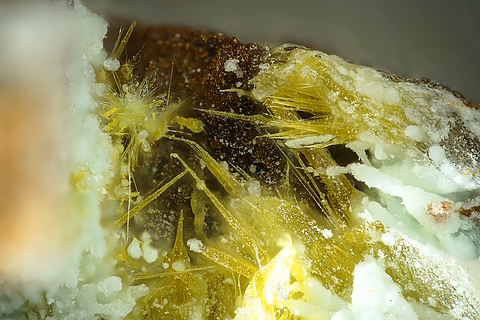
About Blatonite

Chemically, simple uranyl(VI) carbonate monohydrate.
Unique Identifiers
Similar Names
| Billitonite | A variety of 'Tektite' |
| Boltonite | A synonym of Forsterite |
IMA Classification of Blatonite
Classification of Blatonite
5 : CARBONATES (NITRATES)
E : Uranyl Carbonates
B : UO2:CO3 = 1:1
Mineral Symbols
| Symbol | Source | Reference for Standard |
|---|---|---|
| Blt | IMA–CNMNC | Warr, L.N. (2021). IMA–CNMNC approved mineral symbols. Mineralogical Magazine, 85(3), 291-320. doi:10.1180/mgm.2021.43 |
Physical Properties of Blatonite
Optical Data of Blatonite
Based on recorded range of RI values above.
The colours simulate birefringence patterns seen in thin section under crossed polars. They do not take into account mineral colouration or opacity.
Michel-Levy Bar The default colours simulate the birefringence range for a 30 µm thin-section thickness. Adjust the slider to simulate a different thickness.
Grain Simulation You can rotate the grain simulation to show how this range might look as you rotated a sample under crossed polars. Each grain retains its interference colour (retardation) while its brightness falls to black at extinction and reaches a maximum between extinction positions.
Relative to Canada balsam mounting medium (n ≈ 1.537).
For a genuinely uniaxial mineral viewed this way, that cross stays perfectly stationary if you rotate the stage - unlike a biaxial mineral, where it splits apart on rotation. That invariance is itself the standard diagnostic test for telling uniaxial and biaxial minerals apart at the microscope.
Chemistry of Blatonite
Crystallography of Blatonite
X-Ray Powder Diffraction
| d-spacing | Intensity |
|---|---|
| 3.056 Å | (100) |
| 6.56 Å | (77) |
| 6.91 Å | (55) |
| 7.86 Å | (47) |
| 4.76 Å | (40) |
| 4.34 Å | (36) |
| 3.39 Å | (33) |
Geological Environment
| Paragenetic Mode | Earliest Age (Ga) |
|---|---|
| Stage 7: Great Oxidation Event | <2.4 |
| 47a : [Near-surface hydration of prior minerals] | |
| 47c : [Carbonates, phosphates, borates, nitrates] | |
| 47f : [Uranyl (U⁶⁺) minerals] |
Type Occurrence of Blatonite
Synonyms of Blatonite
Other Language Names for Blatonite
Common Associates
| 7 photos of Blatonite associated with Gypsum | CaSO4 · 2H2O |
| 2 photos of Blatonite associated with Alunite | KAl3(SO4)2(OH)6 |
| 2 photos of Blatonite associated with Joliotite | (UO2)CO3 · nH2O |
| 2 photos of Blatonite associated with Magnioursilite | Mg4(UO2)4(Si2O5)5(OH)6 · 20H2O |
| 2 photos of Blatonite associated with Malachite | Cu2(CO3)(OH)2 |
| 1 photo of Blatonite associated with Chukhrovite-(Y) | Ca3YAl2(SO4)F13 · 12H2O |
| 1 photo of Blatonite associated with Magnesiozippeite | Mg(UO2)2(SO4)O2 · 3.5H2O |
| 1 photo of Blatonite associated with Leesite | K(H2O)2[(UO2)4O2(OH)5] · 3H2O |
| 1 photo of Blatonite associated with Serpierite | Ca(Cu2+,Zn2+)4(S6+O4)2(OH)6 · 3H2O |
| 1 photo of Blatonite associated with Rutherfordine | (UO2)CO3 |
Related Minerals - Strunz-mindat Grouping
| 5.EB.05 | Rutherfordine | (UO2)CO3 |
| 5.EB.15 | Joliotite | (UO2)CO3 · nH2O |
| 5.EB.20 | Bijvoetite-(Y) | Y8(UO2)16(CO3)16O8(OH)8 · 39H2O |
Radioactivity
| Element | % Content | Activity (Bq/kg) | Radiation Type |
|---|---|---|---|
| Uranium (U) | 68.3889% | 17,097,225 | α, β, γ |
| Thorium (Th) | 0.0000% | 0 | α, β, γ |
| Potassium (K) | 0.0000% | 0 | β, γ |
For comparison:
- Banana: ~15 Bq per fruit
- Granite: 1,000–3,000 Bq/kg
- EU exemption limit: 10,000 Bq/kg
Note: Risk is shown relative to daily recommended maximum exposure to non-background radiation of 1000 µSv/year. Note that natural background radiation averages around 2400 µSv/year so in reality these risks are probably extremely overstated! With infrequent handling and safe storage natural radioactive minerals do not usually pose much risk.
Note: The mass selector refers to the mass of radioactive mineral present, not the full specimen, also be aware that the matrix may also be radioactive, possibly more radioactive than this mineral!
Activity: –
| Distance | Dose rate | Risk |
|---|---|---|
| 1 cm | ||
| 10 cm | ||
| 1 m |
The external dose rate (D) from a radioactive mineral is estimated by summing the gamma radiation contributions from its Uranium, Thorium, and Potassium content, disregarding daughter-product which may have a significant effect in some cases (eg 'pitchblende'). This involves multiplying the activity (A, in Bq) of each element by its specific gamma ray constant (Γ), which accounts for its unique gamma emissions. The total unshielded dose at 1 cm is then scaled by the square of the distance (r, in cm) and multiplied by a shielding factor (μshield). This calculation provides a 'worst-case' or 'maximum risk' estimate because it assumes the sample is a point source and entirely neglects any self-shielding where radiation is absorbed within the mineral itself, meaning actual doses will typically be lower. The resulting dose rate (D) is expressed in microsieverts per hour (μSv/h).
D = ((AU × ΓU) + (ATh × ΓTh) + (AK × ΓK)) / r2 × μshield
Fluorescence of Blatonite
Other Information
Internet Links for Blatonite
Please feel free to link to this page.
References for Blatonite
Localities for Blatonite
Showing 9 localities.
 symbol to view information about a locality.
The
Locality List
 - This locality has map coordinates listed.
- This locality has estimated coordinates.
ⓘ - Click for references and further information on this occurrence.
? - Indicates mineral may be doubtful at this locality.
 - Good crystals or important locality for species.
 - World class for species or very significant.
(TL) - Type Locality for a valid mineral species.
(FRL) - First Recorded Locality for everything else (eg varieties).
All localities listed without proper references should be considered as questionable.
Czech Republic | |
| Jakub Plasil |
| Travis Olds collection |
Germany | |
| Bayerl et al. (12/21) |
| Möhn et al. (09/2020) |
Italy | |
| Gamboni et al. (2021) |
| Gamboni et al. (2021) |
| //doi.org/10.57635/MICRO.2023.21.9 |
Peru | |
| Douglas Bank Information July 2022 |
USA (TL) | |
| Min News 14:10 p 4 +2 other references |
Jomac Mine, White Canyon Mining District, San Juan County, Utah, USA