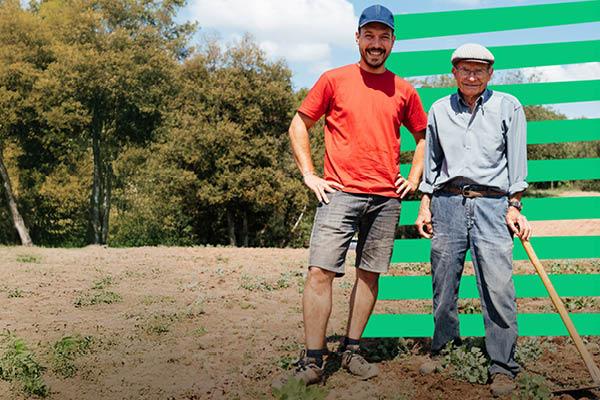
This strategy addresses demographic challenges facing the EU's agricultural sector by attracting and supporting young & entrepreneurial farmers.
The CAP and social sustainability in the EU
Agriculture not only provides for farmers and their families across the EU, it also sustains society as a whole through a number of essential services. In particular, agriculture contributes to society by:
- providing food and other essential materials for citizens,
- acting as the economic backbone of rural communities.
The common agricultural policy (CAP) ensures that farmers can continue to provide these services on a long-term basis by pushing for the economic sustainability of agriculture. In turn, the economic measures of the CAP contain socially inclusive provisions, such as supports for small farmers and redistributive payments.
The environmental actions of the CAP are also designed to be socially sustainable. By supporting management commitments and investments that are beneficial for the environment, the CAP enables all farmers to protect natural resources and biodiversity on behalf of society, an essential service that would otherwise not be remunerated by the market.
Furthermore, through policies and actions that specifically target food security and support rural communities, the CAP ensures that agriculture can contribute to sustainability at all levels of society.


A fairer CAP
The CAP 2023-27 directs support to those who need it most:
- redistribution of income support: EU countries have to dedicate at least 10% of their direct payments to the redistributive income support tool, to better address the income needs of smaller and medium-sized farms;
- active farmers: the new legislation contains a mandatory but flexible definition of an active farmer to be established by EU countries, including the level of activities undertaken. Only active farmers may receive certain EU support;
- social conditionality: CAP payments are linked to the respect of certain EU labour standards and beneficiaries are incentivised to improve working conditions on farms;
- convergence of payments: in the CAP 2023-27 levels of income support converge more, both within individual EU countries and between EU countries;
- supporting young farmers: EU countries have to distribute at least 3% of their direct payments budget towards young farmers, in the form of income or investment support, or start-up aid for young farmers;
- improving the gender balance: gender equality and increasing the participation of women in farming are – for the first time – part of the objectives for CAP Strategic Plans. EU countries must assess these issues and address the identified challenges.
Producing safe and sustainable food
Food security is at the heart of the EU. An early objective of the CAP, one of the EU’s first and biggest policies, was to ensure food security in the aftermath of the Second World War.
To help agriculture meet society’s demands, the CAP pushes for efficient food production that achieves maximum returns for farmers, consumers, and the environment, by:
- transforming production methods and management systems to reduce the use of pesticides and fertilisers and make the best use of nature-based, technological and digital solutions,
- providing a wide range of support actions that strengthen farm income and boost competitiveness,
- funding information and promotion measures to educate consumers about EU agriculture as the safe and sustainable source of their food.
Fostering resilient rural communities
Agriculture acts as the backbone of rural communities across the EU. These communities face a number of challenges, such as ageing demographics and under-developed infrastructure, as well as a lack of services and job opportunities.
The CAP helps to foster resilience in rural communities in a number of ways:
- rural development policy targets social inclusion, job creation and diversification, and developments in rural infrastructure, such as expanding broadband coverage;
- rural development programmes also include support through the LEADER method, which brings together rural communities to prepare and manage local development strategies to face their challenges;
- extra support for farmers in areas facing natural or other specific constraints helps to mitigate against the negative socio-economic consequences of land abandonment, while specific payments for young farmers encourages generational renewal and the durability of rural populations;
- through the common monitoring and evaluation framework (CMEF), the Commission collects comprehensive socio-economic indicators on rural areas, ensuring data-driven solutions for major social issues such as depopulation, poverty, and unemployment.
The CAP also recognises and strengthens the relationship between rural communities and the countryside environment. Measures that protect landscapes, wildlife, and natural resources such as clean air and rivers are not only beneficial for agriculture and the environment: they also contribute to the quality of life in rural areas, as well as opening opportunities for recreational activities and tourism, to further support rural communities.

The Commission is presenting the Vision for agriculture and food, fostering trust and dialogue across the entire value chain within the EU and globally.
The role of knowledge and innovation
Knowledge, research and innovation can inject vitality into rural areas and help to secure a vibrant future for rural communities:
- rural development policy supports innovation in rural areas through the agricultural European innovation partnership and initiatives like smart villages;
- research and innovation in areas such as rural and farming dynamics and policies and enhancing human capital and boosting innovation systems foster the resilience of rural communities and play an important role in stimulating green and socially inclusive economic growth;
- research and innovation is also dedicated to areas such as sustainable, innovative and circular food and non-food value chains, ecological approaches to farming, and digital agriculture, making it possible to achieve food security without putting extra strain on the environment;
- the food production goals of the CAP are further supported by the Joint Research Centre, the Commission’s science and knowledge service, which undertakes research in the area of agriculture and food security.
Related links

Addressing the most frequent questions on the CAP

The Food for Europe podcast is a European podcast series on food and farming, featuring interviews with key players in European agricultural policy.