登录


Kapellasite
A valid IMA mineral species
This page is currently not sponsored. Click here to sponsor this page.



About Kapellasite
Formula:
Cu3Zn(OH)6Cl2
Colour:
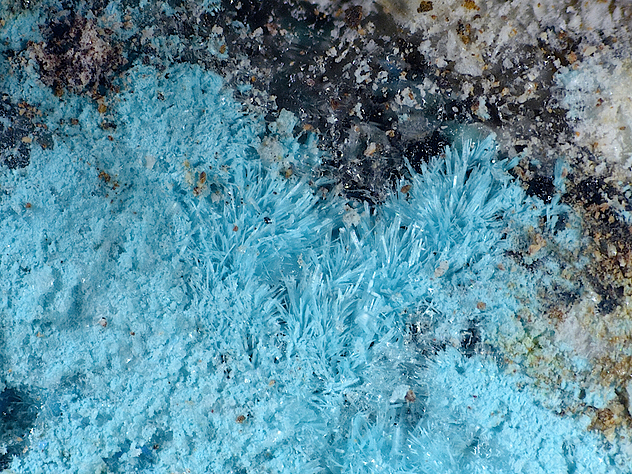
Green-blue
Lustre:
Adamantine
Hardness:
4
Specific Gravity:
3.55
Crystal System:
Trigonal
Member of:
Name:
Named after Christo Kapellas (1938-2004), collector and mineral dealer of Kamariza, Lavrion, Greece. He was one of the foremost experts on the Lavrion minerals.
Type Locality:
Dimorph of:
Isostructural with:
A metastable polymorph of herbertsmithite. Has been confused with botallackite ("Zn-bearing botallackite"; Wendel et al., 1999); both are visually very similar.
Also known as a synthetic compound (phase IIα of Feitknecht and Maget, 1949).
The Mg analogue of kapellasite is called haydeeite.
Also known as a synthetic compound (phase IIα of Feitknecht and Maget, 1949).
The Mg analogue of kapellasite is called haydeeite.
Unique Identifiers
Mindat ID:
27446
Long-form identifier:
mindat:1:1:27446:1
IMA Classification of Kapellasite
Approved
IMA Formula:
Cu2+3Zn2+(OH)6Cl2
Approval year:
2005
First published:
2006
Classification of Kapellasite
3.DA.10c
3 : HALIDES
D : Oxyhalides, hydroxyhalides and related double halides
A : With Cu, etc., without Pb
3 : HALIDES
D : Oxyhalides, hydroxyhalides and related double halides
A : With Cu, etc., without Pb
Mineral Symbols
As of 2021 there are now IMA–CNMNC approved mineral symbols (abbreviations) for each mineral species, useful for tables and diagrams.
| Symbol | Source | Reference for Standard |
|---|---|---|
| Kap | IMA–CNMNC | Warr, L.N. (2021). IMA–CNMNC approved mineral symbols. Mineralogical Magazine, 85(3), 291-320. doi:10.1180/mgm.2021.43 |
Physical Properties of Kapellasite
Adamantine
Transparency:
Transparent
Colour:
Green-blue
Streak:
Light green-blue
Hardness:
4 on Mohs scale
Hardness:
VHN25=200(30) kg/mm2 - Vickers
Tenacity:
Brittle
Cleavage:
Distinct/Good
Parallel to {0001}
Parallel to {0001}
Fracture:
Irregular/Uneven
Density:
3.55(10) g/cm3 (Measured) 3.62 g/cm3 (Calculated)
Comment:
Measured by flotation in Clerici solution. Calculated from the empirical formula.
Optical Data of Kapellasite
Type:
Uniaxial (-)
RI values:
nω = 1.80(1) nε = 1.76(1)
Max. Birefringence:
δ = 0.040
Based on recorded range of RI values above.
Based on recorded range of RI values above.
Interference Colours:
The colours simulate birefringence patterns seen in thin section under crossed polars. They do not take into account mineral colouration or opacity.
Michel-Levy Bar The default colours simulate the birefringence range for a 30 µm thin-section thickness. Adjust the slider to simulate a different thickness.
Grain Simulation You can rotate the grain simulation to show how this range might look as you rotated a sample under crossed polars. Each grain retains its interference colour (retardation) while its brightness falls to black at extinction and reaches a maximum between extinction positions.
Surface Relief:
Very High (positive)
Relative to Canada balsam mounting medium (n ≈ 1.537).
Relative to Canada balsam mounting medium (n ≈ 1.537).
This shows the grain boundary and Becke line effect under plane-polarised
light, based on the contrast between this mineral's average refractive
index and the mounting medium. It does not take into account mineral
colouration.
In focus
Interference Figure:
This shows the idealized uniaxial interference figure - the conoscopic
(convergent-light, Bertrand-lens-in) view, for a grain cut with the optic axis
centred and vertical. The coloured rings are isochromatics, computed with the
same physics as the Michel-Lévy bar above; the dark cross is the isogyre.
For a genuinely uniaxial mineral viewed this way, that cross stays perfectly stationary if you rotate the stage - unlike a biaxial mineral, where it splits apart on rotation. That invariance is itself the standard diagnostic test for telling uniaxial and biaxial minerals apart at the microscope.
For a genuinely uniaxial mineral viewed this way, that cross stays perfectly stationary if you rotate the stage - unlike a biaxial mineral, where it splits apart on rotation. That invariance is itself the standard diagnostic test for telling uniaxial and biaxial minerals apart at the microscope.
Pleochroism:
Strong
Comments:
E = pale green and O = green-blue.
Comments:
Some crystals show biaxial behavior with 2V up to 20 degrees.
Chemistry of Kapellasite
Mindat Formula:
Cu3Zn(OH)6Cl2
Element Weights:
Crystallography of Kapellasite
Crystal System:
Trigonal
Class (H-M):
3m(32/m) - Hexagonal Scalenohedral
Space Group:
P3m1
Cell Parameters:
a = 6.300 Å, c = 5.733 Å
Ratio:
a:c = 1 : 0.91
Unit Cell V:
197.06 ų
Z:
1
Morphology:
Most crystals exhibit a bladed or needle-like irregular habit and are typically strongly distorted with elongation perpendicular to [0001]. Crystallographic forms are {0001} and {1010}.
Twinning:
None observed
Crystal Structure
Load
Unit Cell | Unit Cell Packed
2x2x2 | 3x3x3 | 4x4x4
Unit Cell | Unit Cell Packed
2x2x2 | 3x3x3 | 4x4x4
Show
Big Balls | Small Balls | Just Balls | Spacefill
Polyhedra Off | Si Polyhedra | All Polyhedra
Remove metal-metal sticks
Big Balls | Small Balls | Just Balls | Spacefill
Polyhedra Off | Si Polyhedra | All Polyhedra
Remove metal-metal sticks
Display Options
Black Background | White Background
Perspective On | Perspective Off
2D | Stereo | Red-Blue | Red-Cyan
Black Background | White Background
Perspective On | Perspective Off
2D | Stereo | Red-Blue | Red-Cyan
View
CIF File Best | x | y | z | a | b | c
CIF File Best | x | y | z | a | b | c
Rotation
Stop | Start
Stop | Start
Labels
Console Off | On | Grey | Yellow
Console Off | On | Grey | Yellow
Data courtesy of the American Mineralogist Crystal Structure Database. Click on an AMCSD ID to view structure
| ID | Species | Reference | Link | Year | Locality | Pressure (GPa) | Temp (K) |
|---|---|---|---|---|---|---|---|
| 0014577 | Kapellasite | Krause W, Bernhardt H J, Braithwaite R S W, Kolitsch U, Pritchard R (2006) Kapellasite, Cu3Zn(OH)6Cl2, a new mineral from Lavrion, Greece, and its crystal structure Mineralogical Magazine 70 329-340 | 2006 | Lavrion, Greece | 0 | 293 |
CIF Raw Data - click here to close
X-Ray Powder Diffraction
Powder Diffraction Data:
| d-spacing | Intensity |
|---|---|
| 5.73 Å | (100) |
| 2.865 Å | (11) |
| 2.761 Å | (12) |
| 2.730 Å | (39) |
| 2.464 Å | (81) |
| 1.976 Å | (32) |
| 1.576 Å | (17) |
| 1.519 Å | (10) |
Reference:
Comments:
From type description
Geological Environment
Paragenetic Mode(s):
| Paragenetic Mode | Earliest Age (Ga) |
|---|---|
| Stage 7: Great Oxidation Event | <2.4 |
| 47a : [Near-surface hydration of prior minerals] | |
| 47g : [Halogen-bearing surface weathering minerals] |
Type Occurrence of Kapellasite
General Appearance of Type Material:
Crusts and small aggregates up to 0.5 mm, composed of bladed or needle-like indistinct crystals up to 0.2 mm long.
Place of Conservation of Type Material:
Mineralogical Institute, University of Bochum, Germany, catalogue number IMA-2005-009.
Geological Setting of Type Material:
Formed underground in a mine, from weathering of copper- and zinc-containing ore, in the presence of chloride ions.
Associated Minerals at Type Locality:
Synonyms of Kapellasite
Other Language Names for Kapellasite
Dutch:Kapellasiet
German:Kapellasit
Relationship of Kapellasite to other Species
Member of:
Other Members of Atacamite Group:
| Atacamite | Cu2(OH)3Cl | Orth. mmm(2/m2/m2/m) : Pnma |
| Botallackite | Cu2(OH)3Cl | Mon. 2/m : P21/m |
| Clinoatacamite | Cu2(OH)3Cl | Mon. 2/m : P21/c |
| Gillardite | Cu3Ni(OH)6Cl2 | Trig. 3m(32/m) : R3m |
| Haydeeite | Cu3Mg(OH)6Cl2 | Trig. 3m(32/m) : P3m1 |
| Herbertsmithite | Cu3Zn(OH)6Cl2 | Trig. 3m(32/m) : R3m |
| Hibbingite | Fe2+2(OH)3Cl | Orth. mmm(2/m2/m2/m) : Pnma |
| Iyoite | MnCuCl(OH)3 | Mon. 2/m : P21/m |
| Kempite | Mn2+2(OH)3Cl | Orth. mmm(2/m2/m2/m) : Pnma |
| Kuliginite | Fe3Mg(OH)6Cl2 | Trig. 3 : R3 |
| Leverettite | Cu3Co(OH)6Cl2 | Trig. 3 : R3 |
| Misakiite | Cu3Mn(OH)6Cl2 | Trig. 3m(32/m) : P3m1 |
| Paratacamite | Cu3(Cu,Zn)(OH)6Cl2 | Trig. 3 : R3 |
| Paratacamite-(Mg) | Cu3(Mg,Cu)(OH)6Cl2 | Trig. 3 : R3 |
| Paratacamite-(Ni) | Cu3(Ni,Cu)(OH)6Cl2 | Trig. 3 : R3 |
| Tondiite | Cu3Mg(OH)6Cl2 | Trig. 3m(32/m) : R3m |
| 'Unnamed (Cu-Zn Chloride Hydroxide)' | CuZnCl(OH)3 | Mon. 2/m : P21/m |
Common Associates
Associations Based on Photo Data:
| 14 photos of Kapellasite associated with Gypsum | CaSO4 · 2H2O |
| 10 photos of Kapellasite associated with Hemimorphite | Zn4Si2O7(OH)2 · H2O |
| 4 photos of Kapellasite associated with Cumengeite | Pb21Cu20Cl42(OH)40 · 6H2O |
| 3 photos of Kapellasite associated with Paratacamite | Cu3(Cu,Zn)(OH)6Cl2 |
| 2 photos of Kapellasite associated with Laurionite | PbCl(OH) |
| 2 photos of Kapellasite associated with Woodruffite | Zn2+x/2(Mn4+1-xMn3+x)O2 · yH2O |
| 1 photo of Kapellasite associated with Gordaite | NaZn4(SO4)(OH)6Cl · 6H2O |
| 1 photo of Kapellasite associated with 'Unnamed (Gordaite-related Ca-Zn Sulphate Chloride Hydrate)' | Ca[Zn8(SO4)2(OH)12Cl2](H2O)9 |
| 1 photo of Kapellasite associated with Pseudoboleite | Pb31Cu24Cl62(OH)48 |
| 1 photo of Kapellasite associated with Hydrozincite | Zn5(CO3)2(OH)6 |
Related Minerals - Strunz-mindat Grouping
| 3.DA. | Parahibbingite | Fe2(OH)3Cl |
| 3.DA. | Centennialite | CaCu3Cl2(OH)6 · nH2O (n ~ 0.7) |
| 3.DA. | Bounahasite | Cu+Cu2+2(OH)3Cl2 |
| 3.DA. | Muonionalustaite | Ni3(OH)4Cl2 · 4H2O |
| 3.DA.05 | Melanothallite | Cu2Cl2O |
| 3.DA.10c | Haydeeite | Cu3Mg(OH)6Cl2 |
| 3.DA.10b | Clinoatacamite | Cu2(OH)3Cl |
| 3.DA.10c | Paratacamite | Cu3(Cu,Zn)(OH)6Cl2 |
| 3.DA.10c | Leverettite | Cu3Co(OH)6Cl2 |
| 3.DA.10a | Hibbingite | Fe2+2(OH)3Cl |
| 3.DA.10c | Paratacamite-(Ni) | Cu3(Ni,Cu)(OH)6Cl2 |
| 3.DA.10a | Kempite | Mn2+2(OH)3Cl |
| 3.DA.10c | Tondiite | Cu3Mg(OH)6Cl2 |
| 3.DA.10a | Atacamite | Cu2(OH)3Cl |
| 3.DA.10b | Belloite | Cu(OH)Cl |
| 3.DA.10c | Misakiite | Cu3Mn(OH)6Cl2 |
| 3.DA.10b | Iyoite | MnCuCl(OH)3 |
| 3.DA.10c | Kuliginite | Fe3Mg(OH)6Cl2 |
| 3.DA.10c | Gillardite | Cu3Ni(OH)6Cl2 |
| 3.DA.10b | 'Unnamed (Cu-Zn Chloride Hydroxide)' | CuZnCl(OH)3 |
| 3.DA.10b | Botallackite | Cu2(OH)3Cl |
| 3.DA.10c | Herbertsmithite | Cu3Zn(OH)6Cl2 |
| 3.DA.15 | Claringbullite | Cu4ClF(OH)6 |
| 3.DA.15 | Barlowite | Cu4BrF(OH)6 |
| 3.DA.20 | Simonkolleite | Zn5Cl2(OH)8 · H2O |
| 3.DA.25 | Buttgenbachite | Cu19(NO3)2(OH)32Cl4 · 2H2O |
| 3.DA.25 | Connellite | Cu19(SO4)(OH)32Cl4 · 3H2O |
| 3.DA.30 | Abhurite | Sn21Cl16(OH)14O6 |
| 3.DA.35 | Ponomarevite | K4Cu4Cl10O |
| 3.DA.40 | Calumetite | CaCu4(OH)8Cl2 · 3.5H2O |
| 3.DA.40 | Anthonyite | Cu(OH,Cl)2 · 3H2O |
| 3.DA.45 | Khaidarkanite | Cu4Al3(OH)14F3 · 2H2O |
| 3.DA.50 | Bobkingite | Cu5Cl2(OH)8 · 2H2O |
| 3.DA.55 | Avdoninite | K2Cu5(OH)4Cl8 · H2O |
| 3.DA.60 | Droninoite | Ni6Fe3+2(OH)16Cl2 · 4H2O |
| 3.DA.70 | Chrysothallite | K6Cu6Tl3+Cl17(OH)4 · H2O |
| 3.DA.70 | Dioskouriite | CaCu4Cl6(OH)4 · 4H2O |
| 3.DA.75 | Feodosiyite | Cu11Mg2Cl18(OH)8 · 16H2O |
| 3.DA.80 | Romanorlovite | K8Cu6Cl17(OH)3 |
Fluorescence of Kapellasite
Not fluorescent in LW or SW UV.
Other Information
Health Risks:
No information on health risks for this material has been entered into the database. You should always treat mineral specimens with care.
Internet Links for Kapellasite
mindat.org URL:
https://www.mindat.org/min-27446.html
Please feel free to link to this page.
Please feel free to link to this page.
Search Engines:
External Links:
Mineral Dealers:
References for Kapellasite
Reference List:
Feitknecht, W., Maget, K. (1949) Über Doppelhydroxyde und basische Doppelsalze. Über basische Doppelchloride des Kupfers. Helvetica Chimica Acta, 32 (5). 1653-1667 doi:10.1002/hlca.19490320536
Krause, W., Bernhardt, H.-J., Braithwaite, R.S.W., Kolitsch, U., Pritchard, R. (2006) Kapellasite, Cu3Zn(OH)6CI2, a new mineral from Lavrion, Greece, and its crystal structure. Mineralogical Magazine, 70 (3) 329-340 doi:10.1180/0026461067030336
Janson, O.; Richter, J.; Rosner, H. (2008) Modified Kagome Physics in the Natural Spin-1/2 Kagome Lattice Systems: Kapellasite Cu3Zn(OH)6Cl2 and Haydeeite Cu3Mg(OH)6Cl2. Physical Review Letters, 101 (10). doi:10.1103/physrevlett.101.106403
Zorko, A.; Nellutla, S.; van Tol, J.; Brunel, L. C.; Bert, F.; Duc, F.; Trombe, J.-C.; de Vries, M. A.; Harrison, A.; Mendels, P. (2008) Dzyaloshinsky-Moriya Anisotropy in the Spin-1/2 Kagome Compound ZnCu3(OH)6Cl2. Physical Review Letters, 101 (2). doi:10.1103/physrevlett.101.026405
Colman, R. H.; Ritter, C.; Wills, A. S. (2008) Toward Perfection: Kapellasite, Cu3Zn(OH)6Cl2, a New Model S = 1/2 Kagome Antiferromagnet. Chemistry of Materials, 20 (22). p.6897-6899. doi:10.1021/cm802060n
Localities for Kapellasite
Showing 6 localities.
 symbol to view information about a locality.
The
Locality List
 - This locality has map coordinates listed.
- This locality has estimated coordinates.
ⓘ - Click for references and further information on this occurrence.
? - Indicates mineral may be doubtful at this locality.
 - Good crystals or important locality for species.
 - World class for species or very significant.
(TL) - Type Locality for a valid mineral species.
(FRL) - First Recorded Locality for everything else (eg varieties).
All localities listed without proper references should be considered as questionable.
France | |
| Favreau et al. (2024) |
| Favreau (n.d.) +2 other references | |
Germany | |
| Krause et al. (2006) |
Greece (TL) | |
| Krause et al. (2006) |
Italy | |
| Lecca et al. (2022) |
Spain | |
| Rewitzer et al. (2020) |
Quick NavTopAbout KapellasiteUnique IdentifiersIMA Classification Classification Mineral SymbolsPhysical Properties Optical Data Chemistry Crystallography Crystal StructureX-Ray Powder DiffractionGeological EnvironmentType Occurrence SynonymsOther LanguagesRelationshipsCommon AssociatesStrunz-MindatFluorescence Other InformationInternet Links References Localities Locality List
Sounion Mine No. 19, Cato Sounio mines, Sounion, Lavreotiki, East Attica, Attica, Greece